
Three-Input Frontier
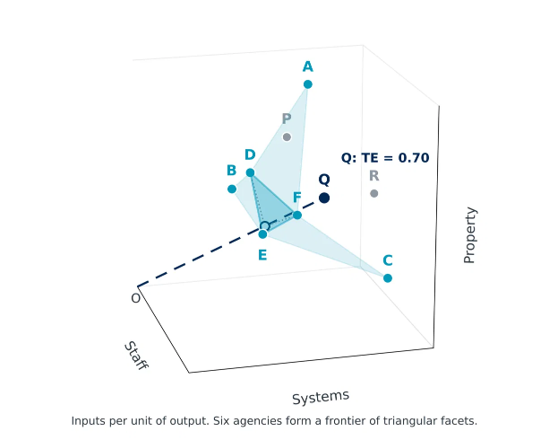
Nine decision-making units (DMUs) each produce one unit of output from three inputs. Six of them form the efficient frontier, a surface of triangular facets. Pick an inefficient DMU to see its ray from the origin, the facet it crosses, its three peers, and Farrell’s calculation worked by hand. Drag the plot to rotate it.
The data
Inputs are per unit of output, so a lower number is better. Read x₁, x₂ and x₃ as, say, staff hours, systems cost and property cost per claim processed.
| DMU | x₁ | x₂ | x₃ | TE | Peers (facet) |
|---|
From two dimensions to three
With two inputs the frontier is line segments with two corners each. With three it is triangles with three corners. A DMU’s ray crosses one facet, and its score comes from that facet’s three corner DMUs: three equations, three weights, TE = 1 ÷ (sum of weights).
From three to n
Nothing new happens. With n inputs each facet has n corners, so you solve n equations for n weights. You can no longer draw it, but the arithmetic is identical. Today a linear program finds the facet and the weights in one step.
What is not drawn
Beyond the outer DMUs (A, B, C) the frontier runs parallel to the axes, Farrell’s “points at infinity”. Those tails are left out to keep the picture readable, except the one DMU R hits.