in defence of Defence
This article was published in The Mandarin 24 July 2026.
I have added some commentary for subscribers. In hindsight, I am not sure I really homed in on the message I was trying to get across.
This isn’t an article about procurement, it’s about trust. Governments lose confidence when the options presented appear incomplete or shaped to favour a preferred outcome. Defence, in turn, comes to distrust political decision-making. That cycle has played out for decades.
If we want “the most significant change to Defence in 50 years” to actually happen, then it requires more than just the organisational change around a new procurement organisation.
I think it raises a broader question. In 2019, an interim report into Australia’s fuel security was released for public consultation. Industry responded. No final report was ever published, although the government subsequently announced a range of fuel security measures.
What options were considered, and what recommendations were made? Which were accepted, modified or rejected? Without the final report, how can Parliament, industry or the public judge whether the government’s decisions were well founded? If policy is to be informed by evidence, shouldn’t the advice and evidence be visible? Who, ultimately, does the APS serve?
Perhaps the subject of a future article. If you have some thoughts on the issue, feel free to email me.
regards
John Glenn
https://www.JayG.com.au
in defence of Defence
The Minister for Defence Industry claims the new Defence arrangements are “the biggest reform to the Defence organisation in 50 years”. While we might forgive a politician for inevitable hyperbole and unbounded enthusiasm, in this case it may well be an undersold opportunity.
In this next chapter, Government is establishing the Defence Delivery Agency (DDA), responsible for acquisition and allied issues, as a separate entity to Defence reporting directly to the Minister(s). The DDA may prove successful, but Defence’s performance depends on much more than organisational restructure.
Defence is too frequently criticised for outcomes that are, in reality, the accumulated consequence of political choices made over decades.
A history of change
Defence has spent half a century reorganising itself.
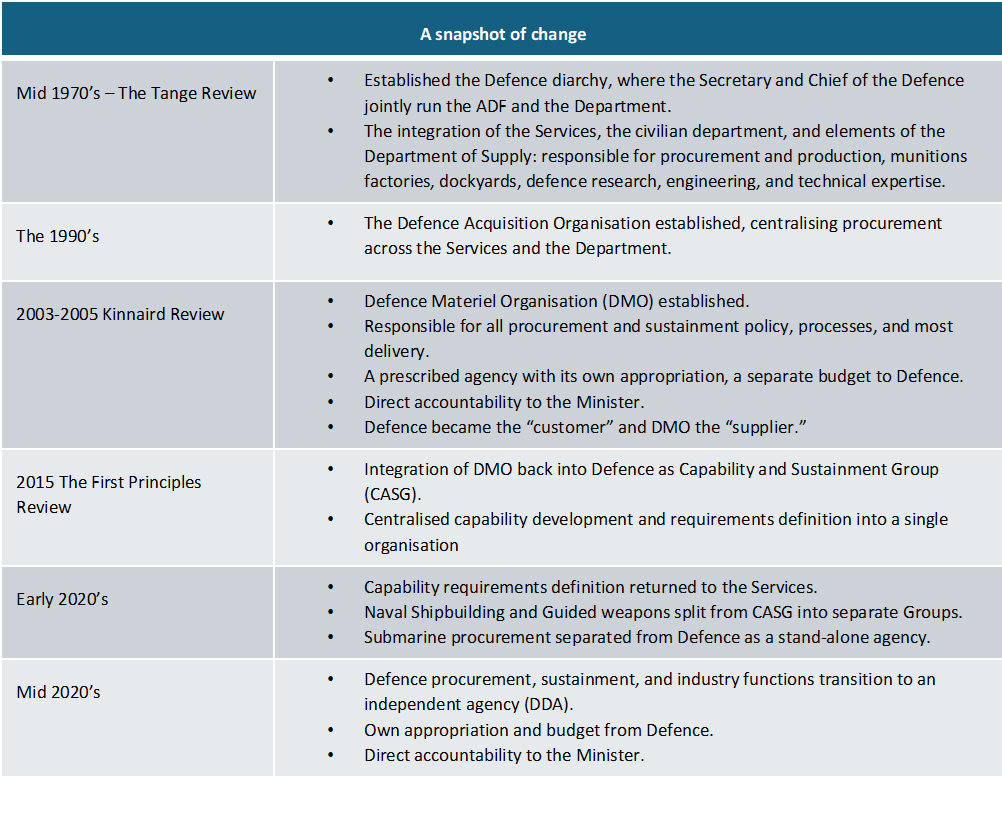
Each reform promised clearer accountability, better governance, and improved delivery. Yet each was followed by another review proposing another structural solution. If the objective is to reduce friction between those who generate capability and those who employ it, the results have been decidedly mixed.
Another organisational change is unlikely to deliver meaningful change by itself. Broader issues, beyond reporting lines, need to be addressed including political decision-making, the diarchy and its confusion between civil control and civil administration, procurement practices, industry engagement, and accountability with consequences.
Ultimately, lasting change needs to start at the top.
The politicians have the right to choose
Defence strategy, priorities, expenditure, force structure, and procurement priorities are properly the choice of the government of the day. However, having the right to choose also creates the obligation to make a choice.
The consequences of political decision-making, or indecision, accumulate over decades and are often invisible. While individual decisions appear reasonable in isolation, their combined effect only becomes apparent much later.
The history of Australia’s Infantry Fighting Vehicle (IFV) illustrates the point. To understand it fully, we must go back to the 1980’s.
The Infantry Fighting Vehicle case study
Project Waler was an initiative to replace the then 20-year-old M113 Armoured Personnel Carrier with 500-1,000 contemporary IFVs (at a cost of about $1bn (~ $3.6bn in today’s dollars). The project was terminated by the Defence Minister, Beazley, as being unaffordable in a period of fiscal restraint.
Instead, the M113 went through an upgrade program delivering 431, theoretically more capable vehicles at a cost of around $1bn. Those vehicles have never been deployed, deemed unfit for combat except in the face of the most benign of threats.
Government addressed the capability gap by spending $2.3bn on 257 wheeled reconnaissance vehicles (ASLAVs) and ~1,000 protected mobility vehicles (Bushmasters).
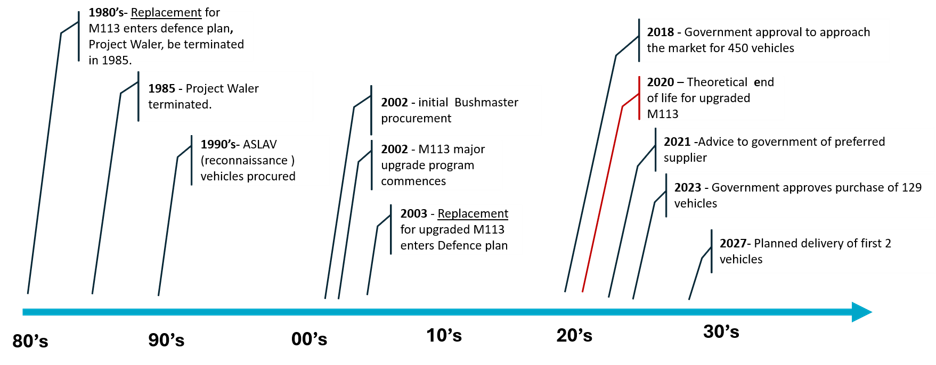
Today, the 431 upgraded M113s are being replaced with 129 Redback IFV at a cost of $7.5bn, and 211 Boxer reconnaissance vehicles superseding the 257 ASLAVs at a cost of $5bn+.
A replacement again entered the defence plan in 2003 to meet the planned end-of-life of the upgraded M113’s. Another 15 years would lapse before Defence was approved to initiate procurement activity for more than 450 vehicles. It then took another 5 years before government approved the contracting for 129 infantry fighting vehicles, accompanied with the direction to accelerate the acquisition to fill a capability gap.
Around $8bn was spent delaying a decision that was inevitable 45 years ago.
Did the delay make a difference?
Eventually there will be a need to seize ground an enemy hold or deny ground they want. It’s the arduous work of a combined arms team, on the ground, face to face, where combat is personal.
The classic infantry unit is a section of eight soldiers broken into two balanced teams of four with well-developed drills and tactics. They can clear houses, traverse obstacles, secure areas, attack fortified positions, man checkpoints, and everything that can’t be done remotely.
They need to deal with surveillance and electronic warfare and deal with the heavy weapons, artillery, air attack, drones before they even get to their objective, while avoiding obstacles and mines, and the terrain, that channels them into killing zones.
They need speed, manoeuvrability, and protection just to get to the enemy. That’s a battlefield taxi.
On the objective they then fight a well-prepared and well-equipped enemy in foxholes, buildings, bunkers and emplacements. They need their own electronic warfare, targeting, communications with air and artillery and other units, medical, specialised weapons, explosives, and ammunition. Lots of it, and heavier weapons than they can carry.
This is an IFV. It stays in the fight. It amplifies the capability of a two-team fighting unit significantly. A battlefield taxi, a Bushmaster or an aged M113, cannot do this.
Understanding the distinction is fundamental. If decision-makers and commentators misunderstand the role of an IFV, capability decisions are inevitably made on unsound foundations.
Some will argue that we didn’t need to spend the money because we were successful without them. Perhaps, but one ought to contemplate what could we have done if we had a contemporarily equipped fighting force. For example, it would have enabled Australia to participate in the mechanised coalition forces during the Iraq conflict.
We might also consider our good fortune in Timor that the Indonesians didn’t respond, forcefully, with a mechanised force. We might also reflect on what we might have achieved at less risk throughout our 20 years in Afghanistan.
It’s not that we didn’t need, or couldn’t use, an IFV. Our success is a testament to our military to get by, to deliver on what is asked of them by politicians, with what politicians deign to allow them to have.
Politicians have the obligation to choose
We took 45 years to decide to buy 129 IFVs instead of 1,000, in an Army that’s about the same size as 1980’s and is under instruction to increase in size, in a more volatile world. Governments of all persuasions make political choices of convenience to balance budgets and address complex priorities that meet both ideological and re-election needs.
They unequivocally have the right to choose, but they also have the obligation to make those choices. They shouldn’t have the luxury of avoiding consequences of their choices by hiding long term impacts outside short-term election cycles. Accountability starts at the top and requires transparency and informed, public, debate.
Deputy Prime Minister Marles made marked commentary in April this year about the worth of public defence debates, noting that “… increases in defence spending do not happen as a result of think tanks, or former generals, or washed-up bureaucrats. It happens by winning arguments around the ERC table.”
That may be true, but the ERC decisions are made without tension. Other policy areas, such as education, health, climate, energy and industry, have informed stakeholders, active lobby groups and enjoy vigorous public debate Defence does not.
ANAO called the IFV a battlefield taxi, undermining the perception of its role and impact. Defence allowed that fundamental misconception to be published to parliament, the recipients of the ANAO report. Government reduced the number of IFVs being procured, with hardly a passing comment publicly. Public debate rarely acknowledged that contemporary doctrine assumes an attacker requires numerical superiority of at least three times the number of defenders. The consequence of the decision to buy 129 IFVs is we had best hope an enemy not have a force greater than 100 people, and even that we could attack only once as we are bound to lose a few vehicles along the way.
That debate was never had.
Contrary to the Deputy Prime Ministers view, we need more strategic commentary, not less. We need to bring the profession of arms out from behind the bureaucrats and allow them to contribute their professional expertise not just to the battlefield but to the consideration of the choice being made on our behalf.
Governments have the right to choose, but the public has the right to assess the consequences of those choices.
The announcements of the Defence organisational restructure may not by itself be the biggest change to Defence in 50 years, but it does offer the biggest opportunity to make meaningful change, starting with politicians accepting that they are also part of the problem.
Responsibility for maladministration, poor policy delivery and inadequate procurement practices sits with the military and the department. Not every ill, however, is of their making. A French General under whom I served many years ago with the UN commented that where you find high performing teams you find high performing leaders. The reverse is also true and a valid criticism of the leadership of Defence over the last fifty years.
It’s not that any single government has failed in their leadership obligations, all of them have. If the Government genuinely wants the biggest reform in fifty years, its focus must be on reducing friction not rearranging it.
It’s not that we need another Defence strategy, but a new strategy for governing Defence.
Published (with much better graphics) in The Mandarin. 24 July 2027 The reform Defence actually needs