

Radical Candor
Kim Scott, Radical Candor (2017, revised 2019)
On the Bookshelf is an occasional series about books I’ve found useful, provocative, disappointing or simply worth thinking about. It began when a client suggested I run a book club. I declined, but what she was really asking for was my thinking, which is the purpose of JayG. These are not so much reviews as reflections on the ideas the books provoke, and how they might be applied.
It is a rare title that does most of the work before you open the cover. Two words for something most of us know we should do and mostly don’t, or if we do, we don’t do it well. Scott makes the point that most poor feedback isn’t harsh, it is absent. She observes that we soften, defer, hint and hope, and call it kindness. The person on the receiving end doesn’t improve, eventually being moved on without ever being told why. I found the avoidance of difficult conversations, personal and commercial, to be endemic in the public sector.
Scott understates the organisational consequences. When we fail to deal with poor performance, we don’t just let down the individual, we let down everyone else who is working hard to make the organisation successful. This is the abrogation of a leader’s responsibility to the organisation, and in the public sector, to the public.
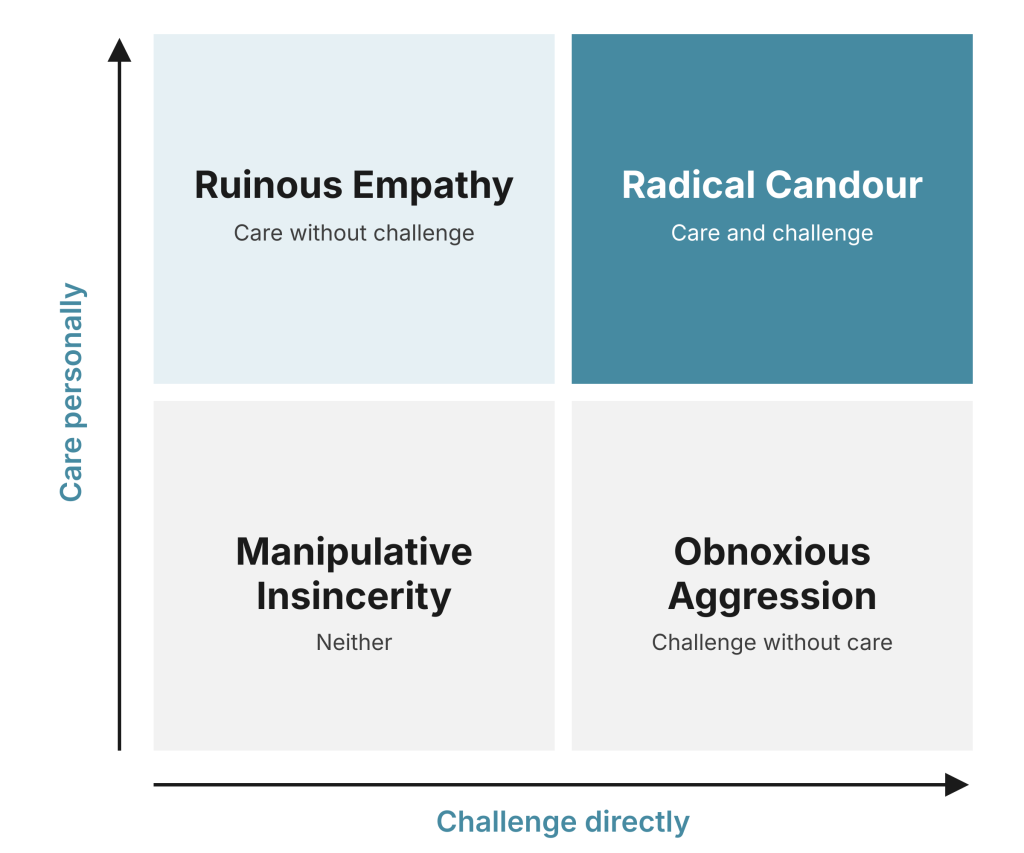
The first half of Scott’s book earns the title. Her framework is simple: care personally, challenge directly. Plot one against the other and you get four quadrants. Radical candour sits where both are high. Obnoxious aggression is challenge without care. Manipulative insincerity is neither. Ruinous empathy is care without challenge. The manager who likes their people too much to tell them the truth.
Ruinous empathy is the quadrant worth the price of the book. Her anecdotes from Google and Apple make the point well, including a boss who pulled her aside about a verbal habit in presentations and pressed harder when the gentle version didn’t land.
The second half was less compelling. It becomes a management manual: one-on-ones, career conversations, running meetings, a wheel for getting things done. Useful if you are a new team lead in a Silicon Valley tech firm, perhaps less so where the organisational chart matters.
While Scott writes mostly about candour flowing down, from manager to report, she does say you should ask for criticism before you give it. Sound theory, but in a hierarchy candour doesn’t flow evenly. Down is easy, up is hard. Rank, careers, reporting lines and the quiet preference for a smooth meeting all push against the junior person who says, “I think we’re wrong.”
I have seen plenty of ruinous empathy, but its institutional cousin, the pursuit of consensus, is more insidious. Company boards are, theoretically, designed to fix this. Directors are appointed to challenge; the permission is formal, written into their duties. Yet a recent issue of Company Director magazine carries a run of pieces on how to create and manage tension in the boardroom where the pull to agreement is strong. If directors, who are obliged and paid to disagree, still need to be coached, it’s not going to be an easy path for the rest of us.
Tough conversations go beyond the individual performance appraisal. Scott offers some things to think about, but organisationally this is a leadership challenge. It is hard to create a safe place for people to object in a hierarchy. Facilitated reviews, and military “after-action” debriefs might help. It does need leaders who embrace the objections, knowing that addressing objections delivers better outcomes. If you want an easy life, don’t be a leader.
We need to break from the hierarchy, be less prescriptive through doctrine, policy, and conformance. While rules have a place, when compliance becomes more important than outcomes, and the questioning of rules is discouraged or too difficult, the very behaviours Scott challenges become institutionally embedded.
Scott has a view on individual conversations, but the lessons are broader, applicable across organisations. It is worth a read if only to challenge ourselves, and the status quo.
One question you might ask, if you lead in a hierarchy, isn’t whether you give candid feedback, but when someone last gave it to you.